Community structure
How do microbial communities differ between shorebirds and poultry, and which environmental or host factors explain those differences?
Project
Metagenomics and AMR ecology across wild birds, poultry and human-influenced environments.
Developing programme
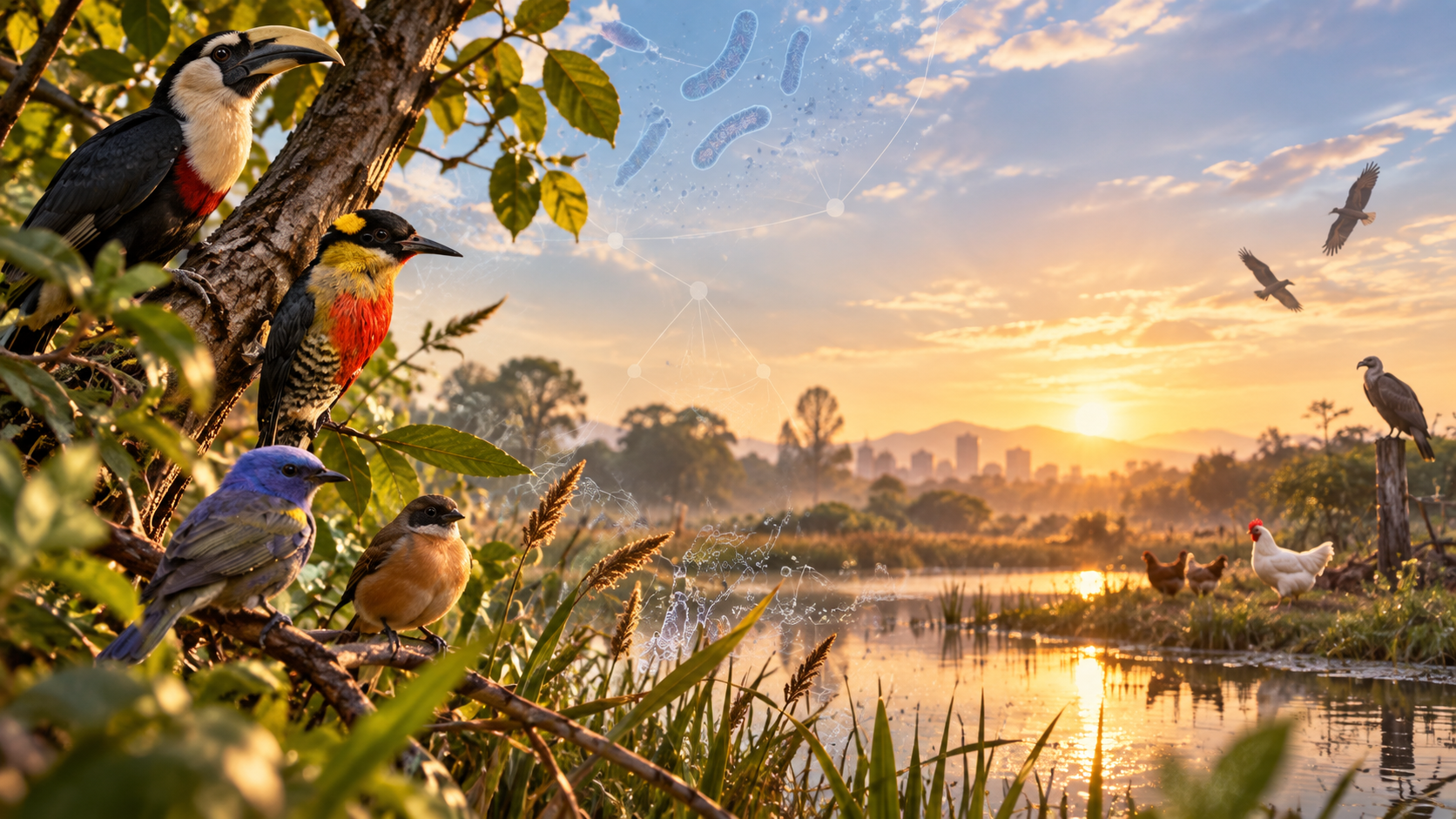
Migratory birds move through coastlines, agricultural landscapes, urban spaces and waste-associated environments. Their microbiomes can therefore reveal how ecological connectivity and human activity shape microbial communities and antimicrobial resistance.
HU-RIZON compares metagenomic data from shorebirds and poultry to investigate taxonomic composition, resistance genes, mobile elements and recoverable microbial genomes. The programme asks not only which genes are present, but which ecological processes best explain their distribution.
Research questions
How do microbial communities differ between shorebirds and poultry, and which environmental or host factors explain those differences?
Which antimicrobial resistance genes and mobile elements are enriched in human-influenced systems?
What can metagenome-assembled genomes reveal about poorly represented species, lineages and host associations?
Do shared genes, genomes or mobile elements support exchange between wildlife, livestock and environmental reservoirs?
Which analytical workflows provide robust, reproducible comparison across complex host-associated metagenomes?
Can wildlife microbiomes act as sentinels of environmental exposure and emerging resistance?
Planned outputs
The project is structured to support a central ecological analysis alongside focused work on methods, resistance, non-bacterial reads and recovered microbial genomes. This avoids forcing every result into a single overloaded paper while preserving a coherent scientific narrative.
Community, resistome and ecological contrasts between poultry and wild birds.
Resistance gene context, sharing and human influence.
Genome recovery, novel diversity and host association.
Practical recommendations for wildlife and One Health metagenomics.
Connected story
A previous population-genomic study showed that proximity to humans was associated with greater lineage and resistance diversity in wild-bird Campylobacter. HU-RIZON widens that lens to the entire microbial community.
Read behind the paper