The ecological question
What happens to wildlife-associated bacteria when birds live closer to us?
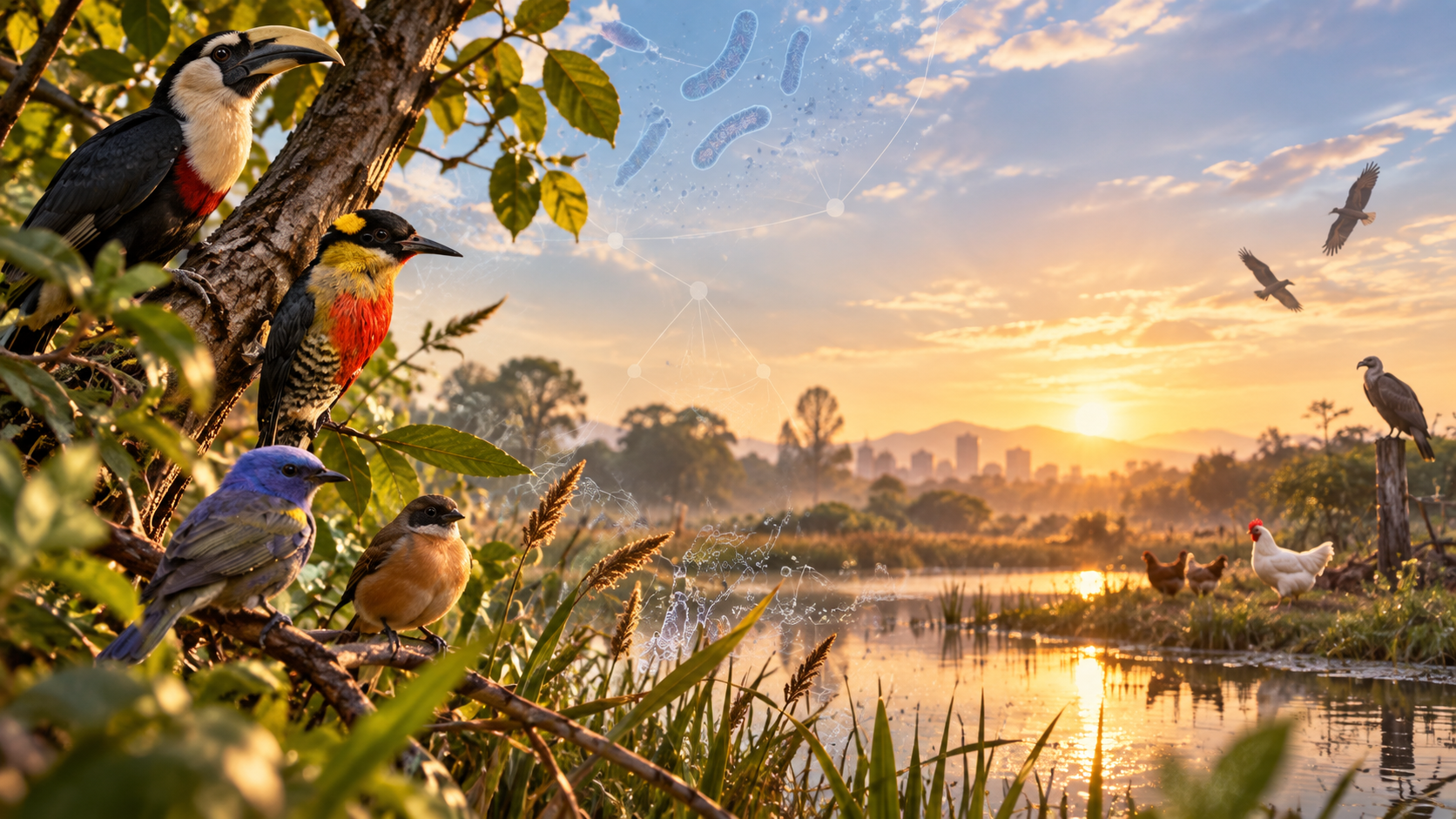
Wild birds move between habitats that humans often treat as separate: coastlines, farms, parks, cities, refuse sites and water systems. Their bacterial communities can therefore record the ecological consequences of urbanisation, food production and waste.
The study compared 700 Campylobacter jejuni isolates from 30 bird species sampled across eight countries. The central question was whether proximity to human activity was associated with bacterial population diversity and antimicrobial resistance.
A stronger human signal in urban birds
Birds living in closer proximity to people carried substantially greater lineage diversity—up to around three times that observed in more remote bird populations. They also carried more resistance, particularly to tetracyclines and fluoroquinolones.
Wildlife is not simply a passive reservoir. It can act as a sentinel of the microbial pressures created by human environments.
The result does not mean that wild birds are the primary cause of antimicrobial resistance. A more plausible interpretation is that they encounter bacteria, genes and residues generated by human and agricultural systems, then redistribute some of that diversity as they move.
Why genomics changes the interpretation
Culture alone can show that resistant bacteria are present. Population genomics reveals whether urban birds carry a broader set of lineages, whether resistance is concentrated in particular populations and how closely those populations resemble bacteria found in other hosts.
This provides a richer ecological warning system. Changes in wildlife-associated bacterial populations may reveal exposure pathways that are difficult to measure directly, including waste, contaminated water and contact with food-production environments.
From one species to the whole microbiome
The HU-RIZON programme expands this question beyond cultured Campylobacter. Metagenomic data can compare entire microbial communities, resistance genes, mobile elements and recoverable genomes across wildlife and poultry. That wider view should help distinguish shared exposure from genuine movement of particular genes or organisms.